ABC Trial.
Visco et al. NEJM 2013. PubMed
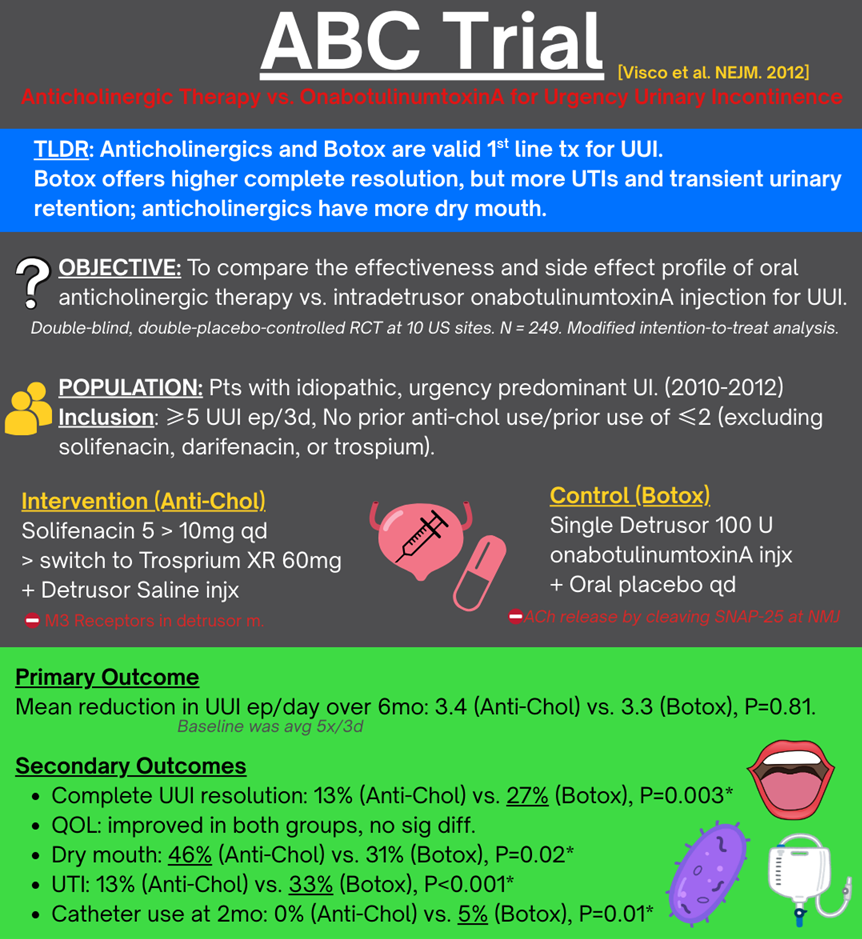
Both treatments reduced UUI episodes equally. Botox had higher cure rates but more UTIs and urinary retention. Anticholinergics had more dry mouth.
Question
In idiopathic urgency urinary incontinence, how does a single intradetrusor injection of 100 U onabotulinumtoxinA compare with 6 months of oral anticholinergic therapy for reducing UUI episodes and improving quality of life?
Design
Population: 249 pts with idiopathic UUI, baseline about 5 UUI episodes/day.
Intervention: Oral anticholinergic therapy for 6 months.
- PO Solifenacin 5mg qd x8wks + Single placebo intradetrusor injection
- If not enough: ↑PO Solifenacin 10mg qd
- If still not enough: Switch to PO Trospium XR 60mg qdComparison: Single 100U intradetrusor onabotulinumtoxinA (botox) injection.
Outcomes
Primary outcome (Anticholinergic vs Botox)
Reduction in daily UUI episodes over 6 months (baseline 5 ep/d): 3.4 ep/d vs 3.3 ep/d. (p=0.81)
Secondary outcomes (Anticholinergic vs Botox)
Complete UUI resolution: 13% vs 27% (p=0.003*)
Complete resolution of all incontinence: 11% vs 23% (p=0.003*)
≥75% reduction in UUI: 40% vs 54% (p=0.06)
QoL (via standardized questionnaire): No difference (p>0.05 for all)
Quiz
1. What is the primary mechanism by which onabotulinumtoxinA (Botox) treats urgency urinary incontinence?
A) Blocking muscarinic receptors on the detrusor muscle
B) Inhibiting acetylcholine release at the neuromuscular junction
C) Enhancing bladder afferent nerve signaling
D) Stimulating β3-adrenergic receptors to relax the bladder
2. When counseling a patient about Botox injection for UUI, which of the following risks should be specifically discussed based on the ABC Trial findings?
A) High risk of severe dry mouth
B) Need for potential intermittent self-catheterization
C) Permanent urinary incontinence
D) Increased risk of bladder cancer
3. Which muscarinic receptor subtype is most directly responsible for detrusor muscle contraction during bladder filling, and is the main therapeutic target of anticholinergic medications?
A) M1
B) M2
C) M3
D) M5
-
B.
Botox cleaves the SNAP-25 proteins And this prevents ACh release at the NMJ.
-
B.
Botox ↑intermittent catheterization, UTI
-
C.
M3 is the receptor responsible for detrusor m. contraction during bladder filling. (Although the bladder is 80% M2 receptors). Solifenacin is a M3 specific antagonist. Trospium is a non-specific muscuranic antagonist.